DMREF Specific Highlights

Enhanced Room Temperature Infrared LEDs
Plasmonic-enhanced emission has been moved toward practical application by the demonstration of an electrically pumped light emitting diode (LED) whose emission properties far exceed state-of-the-art.
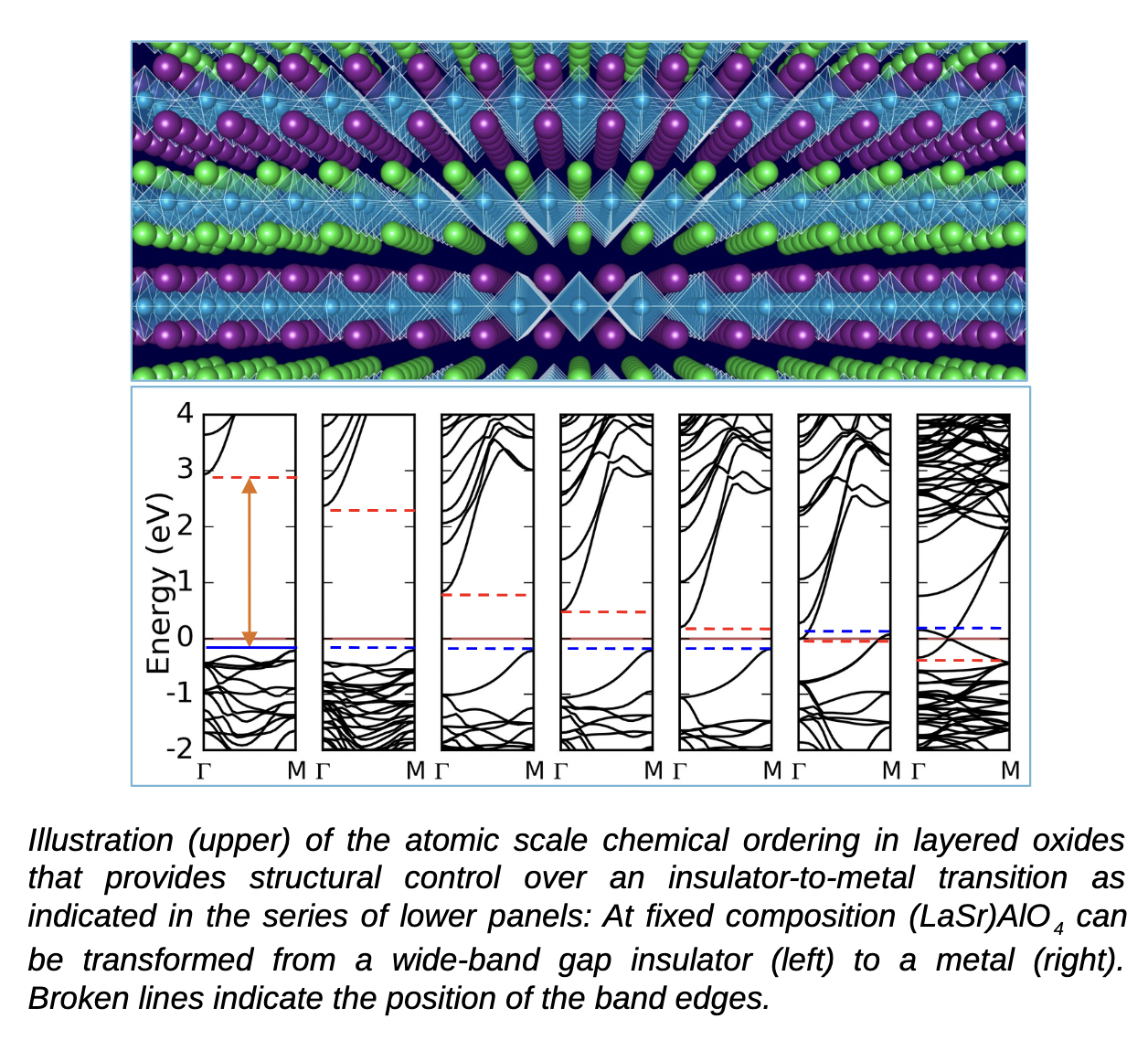
From Insulator to Metal:Chemical Design of Electronic Transitions
James Rondinelli (Northwestern University)
We identified the relationship between local structural distortions, induced by chemical ordering of cations, and the interactions governing the electronic state (insulator or metal) of LaSrAlO4. The structure of this compound hosts a broad range of chemistries known to exhibit metal-to-insulator (MIT) transitions and will enable future materials design.
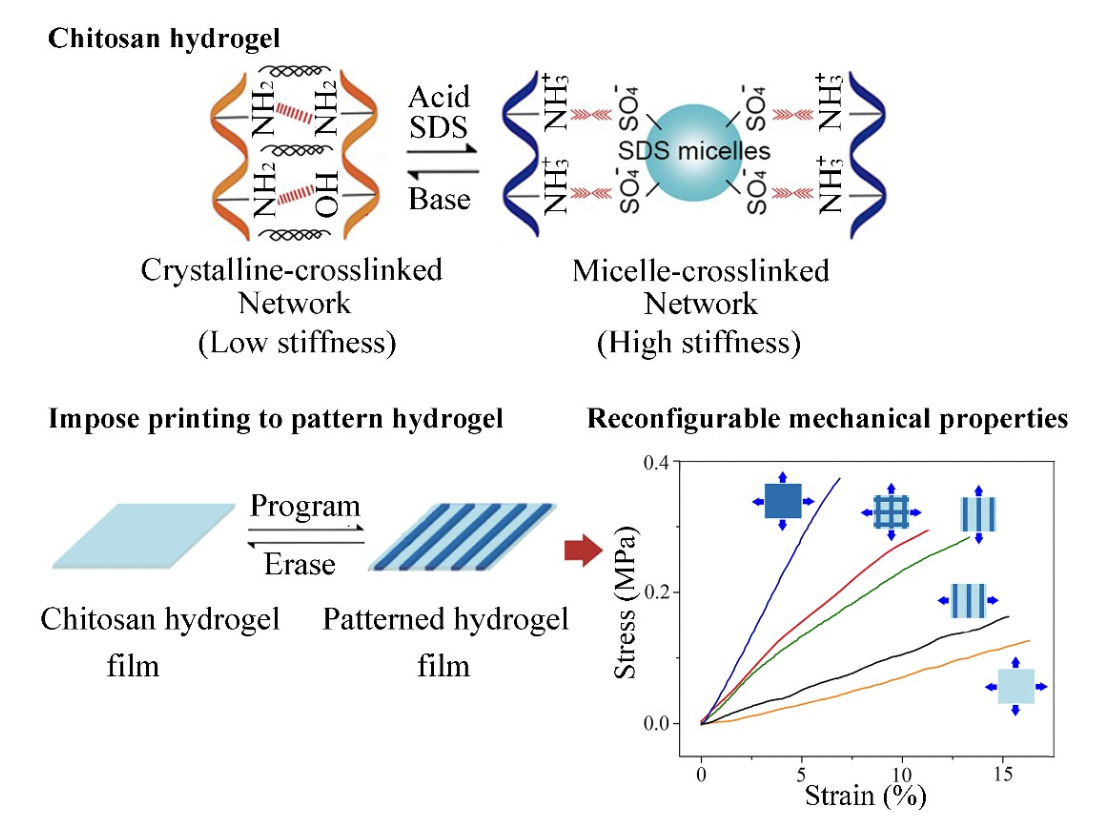
Reconfiguring Hydrogels by Switching Crosslinks
Gregory Payne
In order for biological systems to grow, heal and adapt they must be able to dynamically reconfigure. Using biology as a model, we created a hydrogel with reversibly reconfigurable mechanical properties based on the switching between two physical crosslinking mechanisms. Specifically, we used the renewable aminopolysaccharide chitosan and switched this hydrogel between an elastic crystalline network and a viscoelastic electroastatically crosslinked network.
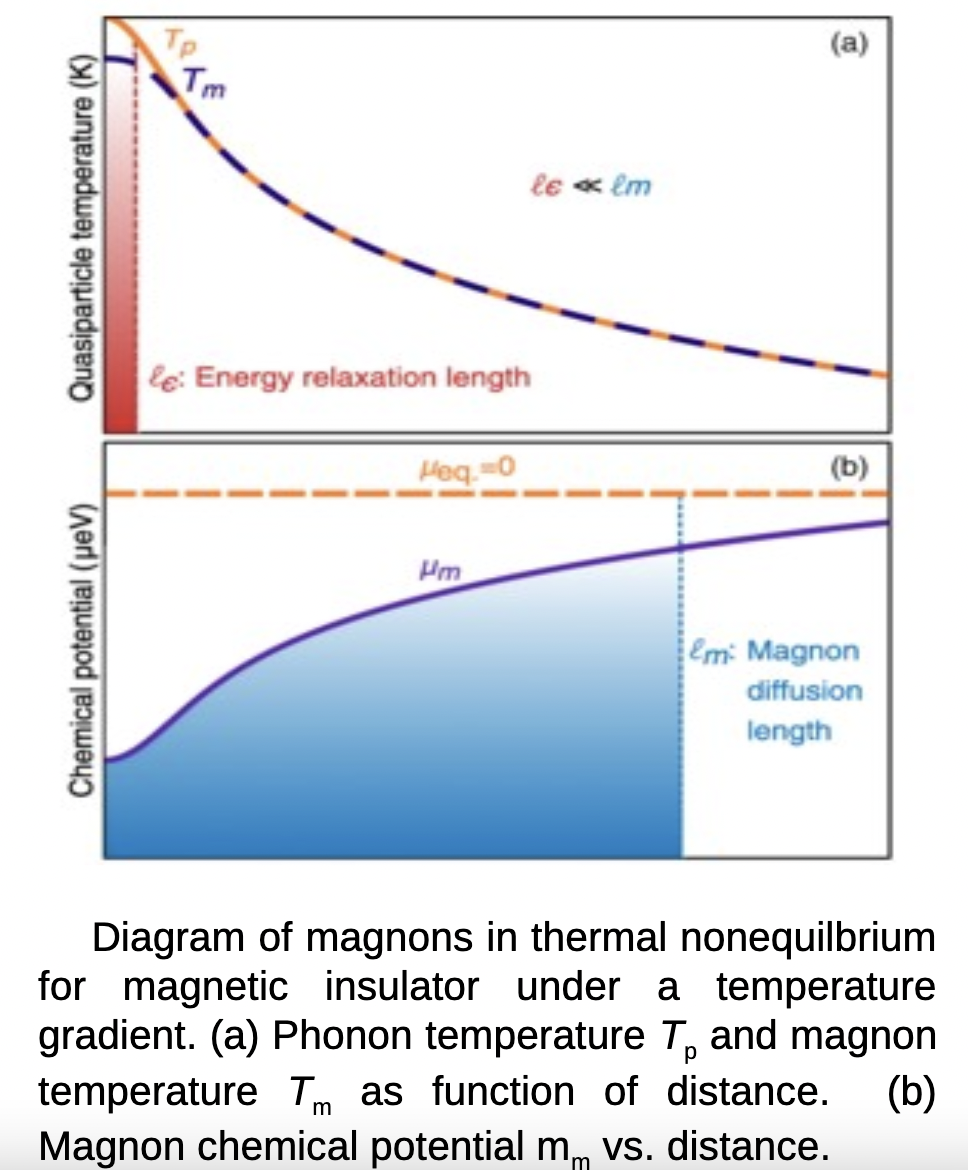
Measurement of a Magnon Chemical Potential
Gregory Fiete (Northeastern University) Jianshi Zhou (University of Texas-Austin)
For a system in equilibrium, the chemical potential of particles whose numbers are not conserved (e.g. phonons, magnons) is zero. However, for a system out-of-equilibrium, such as one where a temperature gradient is applied, there are length and time scales over which the phonon and magnon numbers are approximately conserved. For these length and time scales one may define a chemical potential for the excitations.
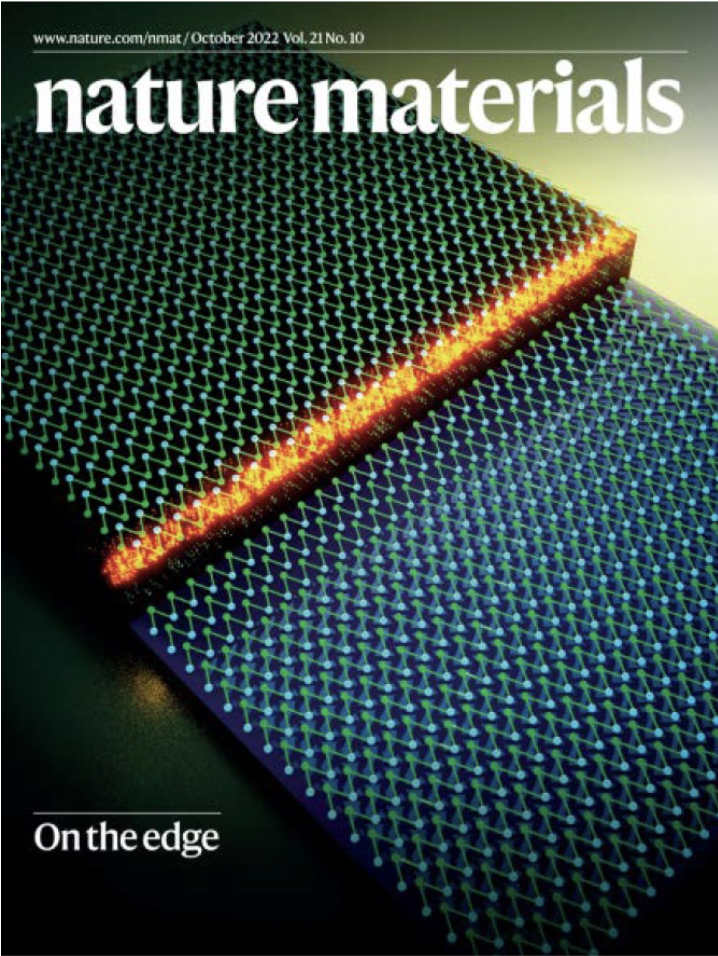
Evidence of a Room-temperature Quantum Spin Hall Edge State in a Higher-order Topological Insulator
Fan Zhang (University of Texas at Dallas)
Room-temperature realization of macroscopic quantum phases is one of the major pursuits in fundamental physics. A topological insulator is a material that behaves as an insulator in its interior but whose surface contains protected conducting states.
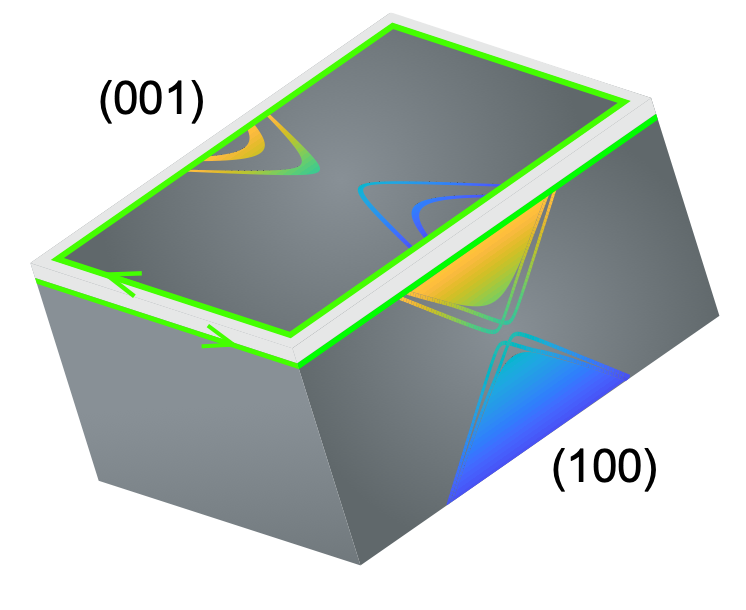
New Topology & Tunable Superconductivity in a-Bi4I4
R.J. Birgeneau (Berkeley), C. N. Lau (Ohio St.),B. Lv, F. Zhang (UT-Dallas), M. Yi (Rice)
Given that 𝜷-Bi4I4 is the first weak topological insulator (TI) (identified by us, but not shown here), that 𝜶-Bi4I4 is a prototype higher-order TI (highlighted here), and that there is a room-temperature transition between the two structural phases (also identified by us, but not shown here), we have established a new (quasi-1D) TI paradigm that unifies the first and second order topological insulators.
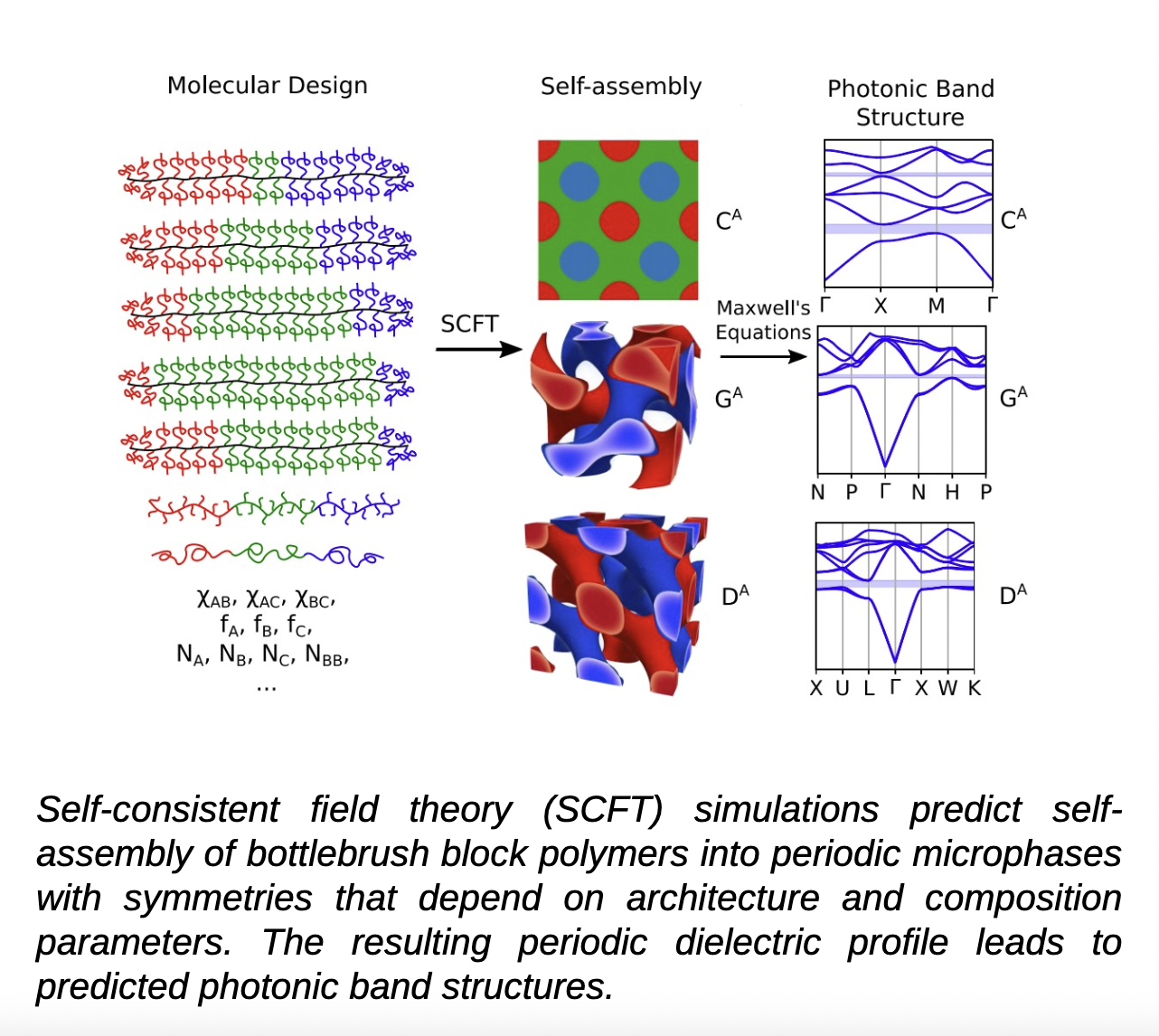
Self-assembled Block Polymers with Complete Photonic Band Gaps
G. Fredrickson, K. Delaney (UCSB)
We have developed a workflow that allows for theoretical prediction of photonic crystals formed from bottom-up self assembly of block polymers. Using established self-consistent field theory (SCFT) methods, we are able to predict the symmetries of stable periodic structures formed at lengths scales of 10s-100s nm by such materials. Following structure prediction, photonic band structures are predicted by solving Maxwell’s equations on the resulting periodic dielectric profile.
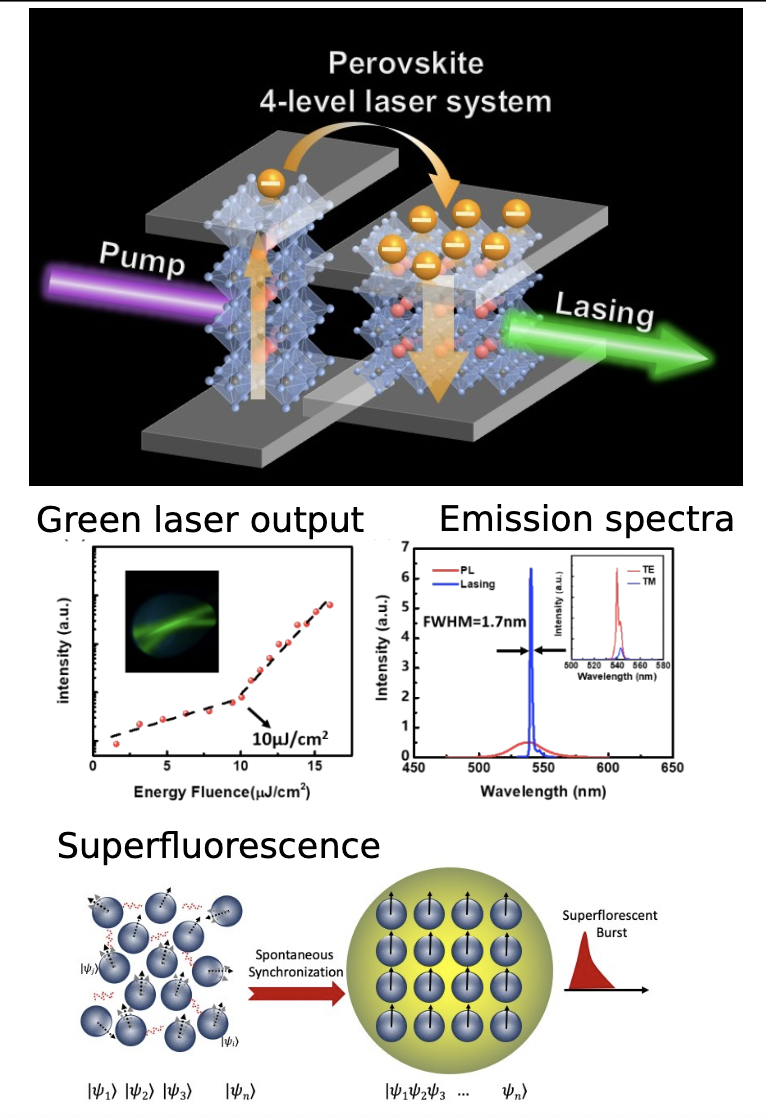
Quasi 2D Perovskite Laser
K. Gundogdu, F. So (NC St. U.)
The So and Gundogdu groups demonstrated a highly efficient, low threshold optically pumped perovskite laser. In quasi 2D perovskites, exciton funneling into low energy 3D domains functions as the gain medium.
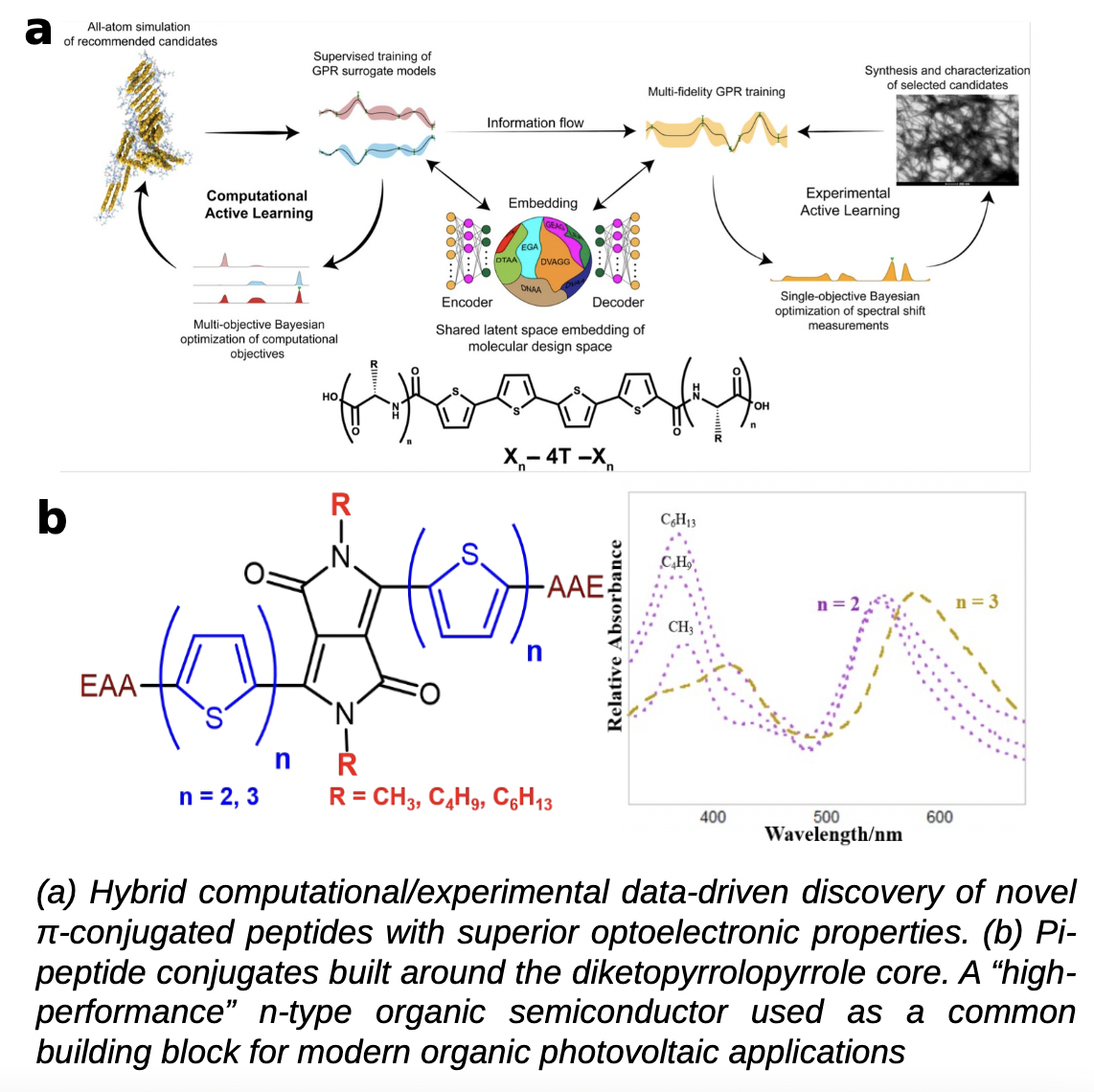
Self-assembled Peptide-p-electron Supramolecular Polymers for Bioinspired Energy Harvesting, Transport, and Management
J. Tovar (Johns Hopkins U.)A. Ferguson (U. Chicago)
This project integrates experiment, simulation, and data-science to engineer supramolecular optoelectronic peptidic semiconductors.
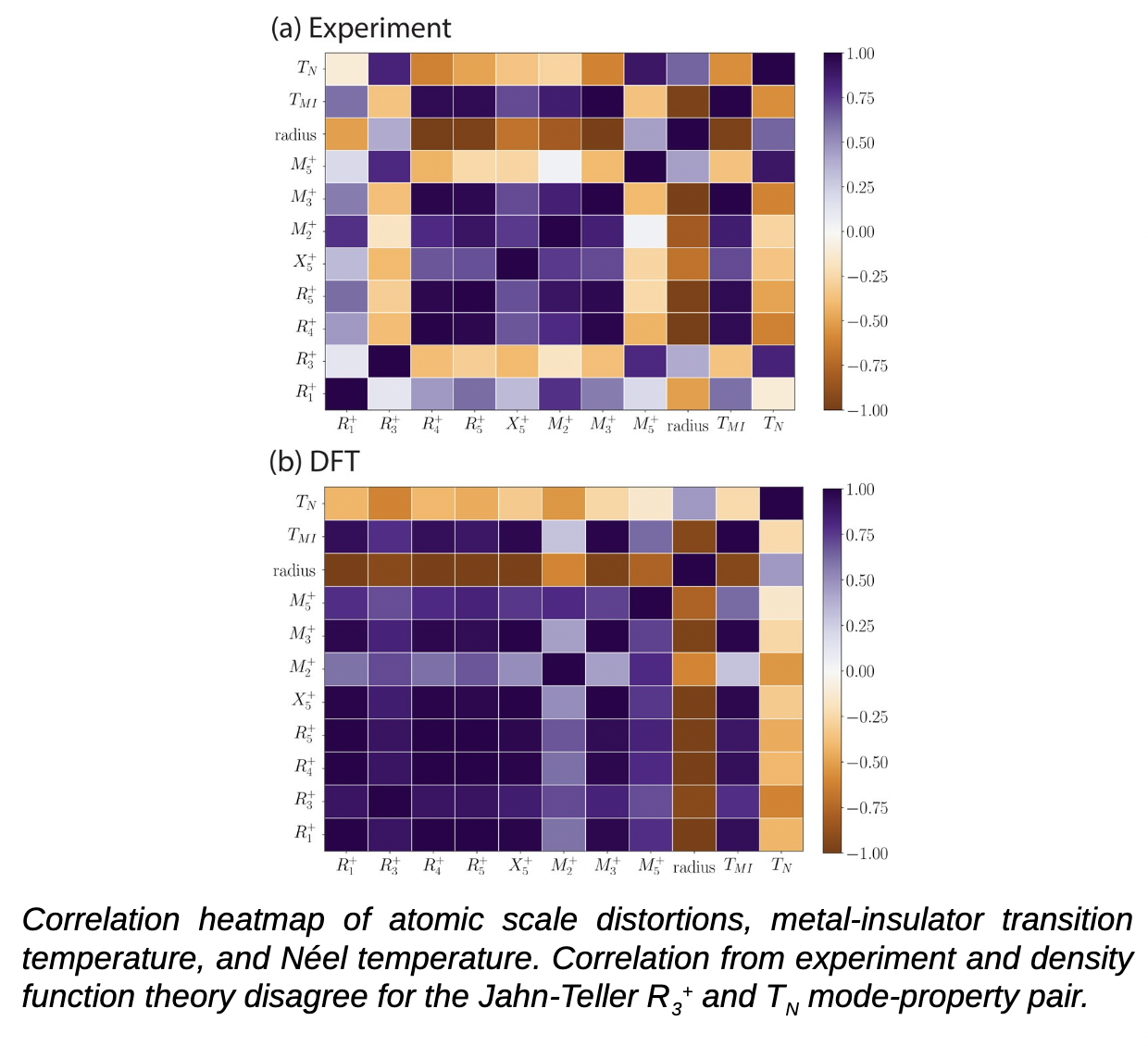
Learning from Correlations:Rare-earth Nickelates Revisited
James Rondinelli (Northwestern University)
We conducted a statistical study of the correlations between local structural distortions and critical transition temperatures of the RNiO3 family of compounds (R=rare earth). We showed gaps in scientific understanding of the reported structures of these materials known to exhibit metal-insulator and magnetic transitions and explained the discrepancies with DFT calculations.
Showing 101 to 110 of 120