Machine Learning-enabled Computational Discovery of Self-assembling Biocompatible Nanoaggregates

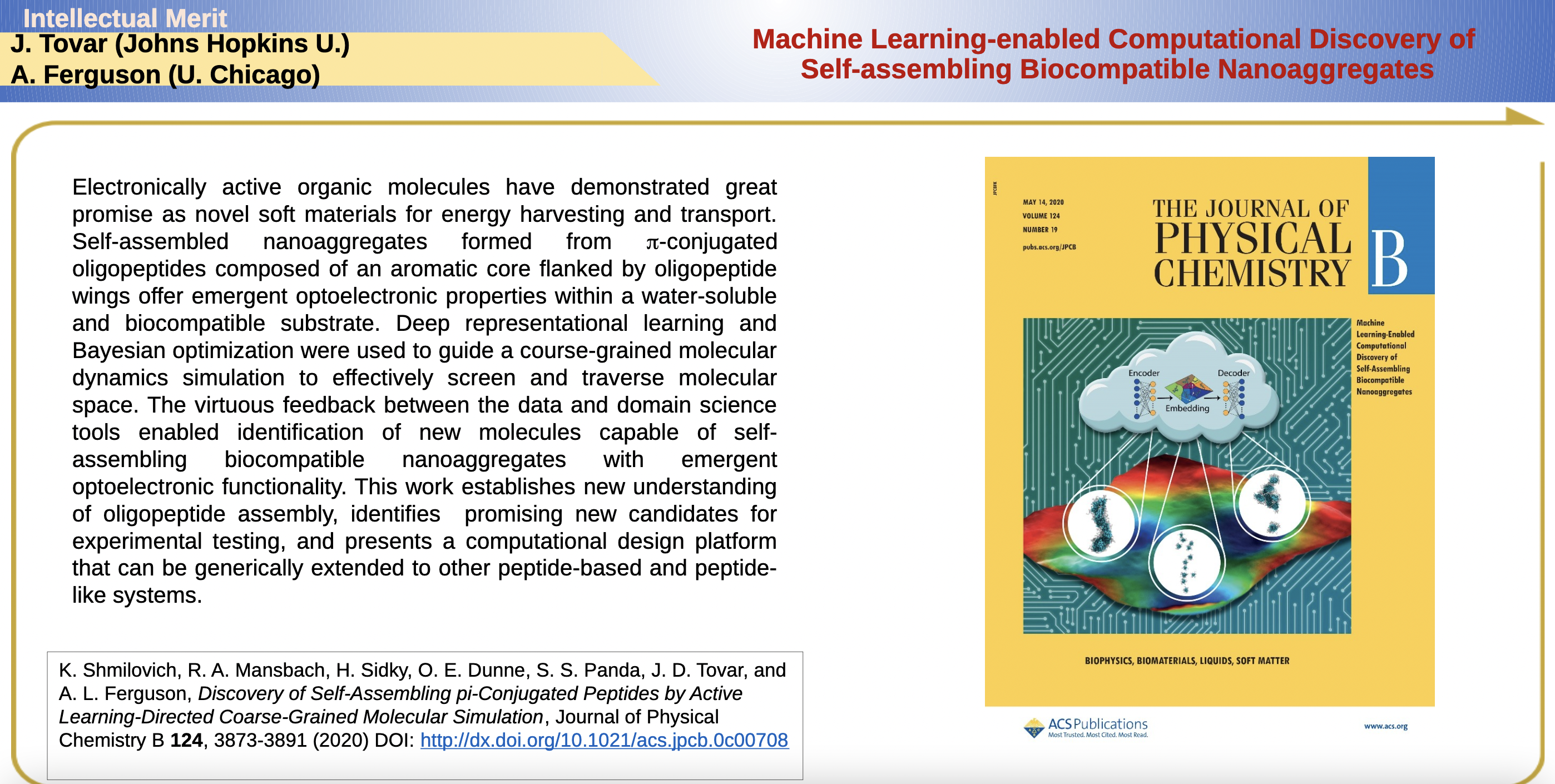
Electronically active organic molecules have demonstrated great promise as novel soft materials for energy harvesting and transport. Self-assembled nanoaggregates formed from p-conjugated oligopeptides composed of an aromatic core flanked by oligopeptide wings offer emergent optoelectronic properties within a water-soluble and biocompatible substrate. Deep representational learning and Bayesian optimization were used to guide a course-grained molecular dynamics simulation to effectively screen and traverse molecular space. The virtuous feedback between the data and domain science tools enabled identification of new molecules capable of self-assembling biocompatible nanoaggregates with emergent optoelectronic functionality. This work establishes new understanding of oligopeptide assembly, identifies promising new candidates for experimental testing, and presents a computational design platform that can be generically extended to other peptide-based and peptide-like systems.